Application Programming Interface (API)
APIs are the invisible engines behind every app, website, and smart device we use today. From booking a ride to streaming music to powering AI systems, APIs make technology talk—and those who understand them shape the future.
At Tune‑Up Skills, our API course transforms learners into confident creators who can design, connect, and automate digital systems with real‑world impact. Whether you’re a beginner exploring how apps communicate or a professional ready to build scalable integration, this course gives you the hands‑on skills to thrive in today’s connected world.
Master Non‑Technical API Skills in Few Weeks and Step Into 2026 Career Opportunities
As the year comes to a close, this is your moment to invest in a skill that truly moves you forward. Join Our Non-Technical API Program and Step Into 2026 With New Career Opportunities.
Our Non‑Technical API Skills Program is designed for students, career‑switchers, and curious learners who want to understand how modern digital systems connect — without writing a single line of code.
In just few weeks, you’ll gain practical, industry‑relevant API literacy that helps you stand out in today’s digital job market. From understanding how apps communicate to exploring real business use cases, you’ll build the confidence to speak the language of modern technology.
And there’s more, as a Tune‑Up Skills learner, you’ll also gain access to opportunity referrals through our growing network of partners across the United States and Canada.
These connections open doors to internships, entry‑level roles, project opportunities, and pathways into tech‑enabled careers.
Understand How Digital Systems Connect — Without Writing Code
APIs power almost everything we do online — from sending money to tracking packages to logging in with Google. But you don’t need to be a programmer to understand how they work or how they shape modern business.
Our Non‑Technical API Course is designed for learners who want to understand the concepts, use cases, and real‑world value of APIs without diving into code.
It’s perfect for beginners, business leaders, product thinkers, and anyone curious about how digital systems communicate. We don’t just teach concepts—we build creators.
Our curriculum is practical, visual, and project-driven, designed to spark curiosity and build confidence. Every learner walks away with real API experience they can showcase in portfolios, interviews, and future projects.
🔄 API Process Simplified
Think of an API as a messenger that carries requests and brings back answers between two digital systems.
Here’s the process in four clean steps:
✅ 1. A Request Is Made
A user or system wants something — for example:
- “Show me today’s weather.”
- “Log me in with Google.”
- “Track my package.”
This request is sent to an API.
✅ 2. The API Delivers the Request to the Server
The API takes the request and brings it to the system that has the information — the server.
It’s like a waiter taking your order to the kitchen.
✅ 3. The Server Processes the Request
The server checks:
- What information is being asked for
- Whether the user has permission
- How to gather the correct data
Then it prepares the response.
✅ 4. The API Returns the Response
The API brings the answer back to the requester.
Examples:
- Weather data
- User profile information
- Package location
- Payment confirmation
This response is usually delivered in a structured format like JSON, which apps can easily understand.
🌐 A Simple Real‑World Example
You open a ride‑sharing app → You request a ride → The API sends your request to the server → The server finds nearby drivers → The API sends the results back to your app.
In summary, API = Messenger that carries requests from an app to a server and brings back the response.
Visual Breakdown : How an API Works
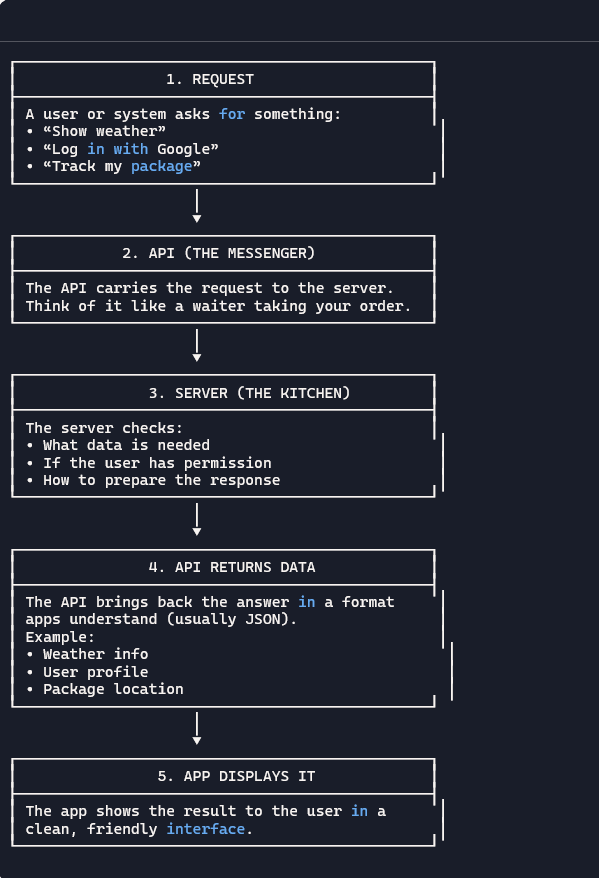
You never see the API — but it’s doing all the communication behind the scenes.
Why This Course Matters for Non‑Technical Roles
Understanding the API process helps students:
- Communicate better with developers
- Plan integrations and digital workflows
- Understand how modern apps and businesses operate
- Participate confidently in tech‑enabled projects
- Qualify for non‑technical roles in product, operations, logistics, customer success, and more
What Learners Will Understand (No Coding Required)
- What APIs Are – Simple, visual explanations of how apps and systems exchange information.
- Why APIs Matter – How APIs power logistics, banking, healthcare, education, e‑commerce, and everyday apps.
- Real‑World API Examples – Ride‑sharing, weather apps, payment gateways, social media logins, automation tools, and more.
- How Businesses Use APIs – Integrations, partnerships, automation, data sharing, and digital transformation.
- API Security Basics – Tokens, permissions, and why protecting data matters — explained in plain language.
- How to Read an API – Understanding endpoints, requests, and responses
- Hands‑On, No‑Code Activities – Use visual tools to connect apps, automate workflows, and explore real API data.
What Learners Will Discover
- How APIs work and why they’re essential in modern software
- RESTful API design, endpoints, requests, and responses
- Authentication & security (API keys, tokens, best practices)
- Building and testing APIs using industry‑standard tools
- Connecting apps and automating workflows with real-world examples
- Hands‑on projects that simulate real developer tasks
Who This Course Is For
- Professionals/Consultants
- Solution Architects
- Product Managers
- Business Analysts
- Operations/Integration Teams
- Technical Writers
- Entrepreneurs who need API literacy to make smarter decisions.
Where API Knowledge Can Take You
APIs are the backbone of modern digital systems — and mastering them opens doors across the entire tech ecosystem. Whether learners are just starting out or already building their careers, API skills unlock high‑growth, future‑proof opportunities.
Non-Technical High‑Demand Career Paths:
- API Business Analyst : Focuses on gathering requirements, documenting APIs, mapping business processes, and explaining API behavior to stakeholders.
- API Product Manager : Owns the API as a product, defines strategy, manages life-cycle, prioritizes features, and aligns API delivery with business goals.
- API Technical Writer : Creates API documentation, SDK guides, Postman collections, tutorials, and developer on-boarding guides.
- API Consultant / Solutions Architect : Advises companies on API strategy, integration, digital transformation, API monetization, and enterprise modernization.
- API Integration Specialist : Connects multiple systems (ERP, EMR, CRM, EDI, banking, logistics) using APIs, middleware, and automation tools.
Technical High‑Demand Career Paths:
- API Developer / API Engineer : Builds, integrates, and maintains APIs using REST, SOAP, GraphQL, and cloud platforms.
- API Integration Specialist : Connects multiple systems (ERP, EMR, CRM, EDI, banking, logistics) using APIs, middleware, and automation tools.
- API Architect : Designs enterprise API architecture, API gateways, security frameworks, scalability models, and micro-services structures.
- API Test Engineer / QA Engineer :Tests APIs using Postman, JMeter, ReadyAPI, Newman, and automated test frameworks. Ensures performance, security, and reliability.
- API Security Engineer : Focuses on OAuth2, JWT, API keys, rate limiting, threat modelling, penetration testing, zero-trust frameworks, and WAF/Gateway security.
- API Governance & Compliance Analyst : Implements API standards, naming conventions, access policies, versioning rules, audit logs, GDPR, HIPAA, SOC 2 alignment, and lifecycle governance.
- API Platform Engineer : Manages enterprise API platforms like Apigee, Kong, Azure API Management, Mulesoft, WSO2, Boomi. Handles gateway, routing, quotas, analytics.
- API Data Analyst : Uses API logs, usage metrics, errors, latency data, and analytics platforms to optimize performance and improve business decisions.
- API DevOps / Automation Engineer : Implements CI/CD pipelines for API deployments, automated testing, monitoring, and containerization using Kubernetes, Docker, GitHub Actions.
Career & Practical Benefits
- Understand how modern apps and platforms communicate
- Communicate better with developers and technical teams
- Improve product planning and digital strategy
- Use APIs to automate workflows and save time
- Build confidence in tech without learning programming
- Strengthen employability in any digital‑first industry
Why These Paths Matter
- APIs are used in every industry — finance, logistics, healthcare, education, retail, energy, and more.
- API‑driven roles are among the fastest‑growing in tech.
- API skills increase earning potential and open doors to remote, global opportunities.
- Even non‑developers benefit, because APIs power automation, analytics, and digital transformation.
Curriculum
- 11 Sections
- 103 Lessons
- 3 Weeks
- MODULE 1 — Introduction to APIs & Modern IntegrationsTopics Covered • What Is an API (Business, Simple, Technical) • REST Vs SOAP • JSON Vs XML • API Request and Response Structure • URI, Endpoints, Headers, Body, Query Params • How Businesses Use Apis (Banking, Retail, Healthcare, Logistics) • API Lifecycle and SDLC • Role of an API Business Analyst Hands-On Labs • Call A Public API Using Postman • Review Request and Response • JSON Formatting and Breakdown Deliverables • API Explanation Assignment • Identify API Components Workbook10
- 1.1API Request and Response Structure
- 1.2API Lifecycle and SDLC
- 1.3URI, Endpoints, Headers, Body, Query Params
- 1.4How Businesses Use Apis (Banking, Retail, Healthcare, Logistics)
- 1.5What Is an API (Business, Simple, Technical)
- 1.6Role of an API Business Analyst
- 1.7JSON Vs XML
- 1.8REST Vs SOAP
- 1.9Hands-On Labs
- 1.10Deliverables
- MODULE 2 — Requirements Gathering for API ProjectsTopics Covered • Gathering Business Requirements • Functional Vs Non-Functional Requirements • API Use Cases and User Journeys • Workflow Documentation (BPMN, UML) • Stakeholder Interview Templates • Hands-On Labs • Build A BRD • Write API Use Cases • Create Workflow Diagrams Deliverables • Completed BRD10
- MODULE 3 — API Specifications (Swagger / OpenAPI)Topics Covered • Swagger and OpenAPI Fundamentals • Designing Endpoints • HTTP Methods And Status Codes • Authentication Methods • Schemas And Data Models • API Contracts Hands-On Labs • Build Customer and Order API Specs • Test Using Swagger UI Deliverables • First Complete API Specification9
- MODULE 4 — Data Mapping for APIsTopics Covered • Source-To-Target Mapping • JSON Structure and Hierarchy • JSON To XML • JSON And EDI (850, 810, 856, 270/271) • Mapping Sheets, Loops, Objects, Cardinality Hands-On Labs • Build Order API Mapping Sheet • Convert JSON Input to Schema to Output Deliverables • Data Mapping Document7
- MODULE 5 — API Design Patterns & ArchitectureTopics Covered • Synchronous Vs Asynchronous Apis • Webhooks Vs Polling • API Orchestration • Microservices Basics • API Gateways • Versioning, Rate Limiting, Pagination Hands-On Labs • Order To Inventory to Shipping Workflow • Architecture And Sequence Diagrams Deliverables • Architecture Diagram • Sequence Diagram10
- MODULE 6 — API Testing & Quality AssuranceTopics Covered • API Testing Fundamentals • Postman Deep Dive • Manual Vs Automated Testing • Authentication And Negative Testing • Contract Testing and Mock Servers Hands-On Labs • Build Postman Collection • Multi-Dataset Testing • Write Test Cases Deliverables • API Test Plan • Test Cases10
- MODULE 7 — Integration Platforms (Boomi iPaaS)Topics Covered • Why Companies Use iPaaS • Role Of API BA In Boomi Projects • REST Listeners and Connectors • JSON And XML Profiles • API To ERP To EDI Flows • Trading Partners and Modernization Hands-On Labs • REST Listener to Mapping to DB Or EDI Flow • Test With Postman Deliverables • Working Mini Integration9
- MODULE 8 — Security, Governance & ComplianceTopics Covered • Authentication Vs Authorization • OAuth2, JWT, API Keys • Identity Providers • Governance Frameworks • SLAs And Versioning • Compliance (HIPAA, GDPR, SOC2, PCI) Hands-On Labs • Create Governance Document • Secure API With API Key Deliverables • API Governance Framework9
- MODULE 9 — API Project Documentation & Agile DeliveryTopics Covered • API-Focused User Stories • Acceptance Criteria • Epics, Features, Stories, Tasks • Sprint Planning and Backlog Management • Working With Product Owners and Development Teams • Confluence-Style Documentation • Release Notes • Change Requests and Scope Control Hands-On Labs • Write 10 Real API User Stories • Build An API Project Documentation Page Deliverables • Agile Story Backlog • API Project Documentation Pack12
- 9.1Sprint Planning and Backlog Management
- 9.2Epics, Features, Stories, Tasks
- 9.3API-Focused User Stories
- 9.4Working with Product Owners and Development Teams
- 9.5Confluence-Style Documentation
- 9.6Acceptance Criteria
- 9.7Release Notes
- 9.8Change Requests and Scope Control
- 9.9Write 10 Real API User Stories
- 9.10Build An API Project Documentation Page
- 9.11Agile Story Backlog
- 9.12API Project Documentation Pack
- MODULE 10 — FINAL REAL-WORLD CAPSTONE PROJECT• End-to-End Flow Example • Customer to API to Integration Layer to EDI or ERP to Response API • Final Capstone Deliverables • Business Requirements Document • API Specification (Swagger / OpenAPI) • Data Mapping Sheet • Architecture Diagram • Sequence Diagram • Postman Test Suite • Integration Design (Boomi-style flow) • Final Presentation11
- 10.1Data Mapping Sheet
- 10.2Business Requirements Document
- 10.3Final Capstone Deliverables
- 10.4API Specification (Swagger / OpenAPI)
- 10.5End-to-End Flow Example
- 10.6Customer to API to Integration Layer to EDI or ERP to Response API
- 10.7Architecture Diagram
- 10.8Sequence Diagram
- 10.9Postman Test Suite
- 10.10Integration Design (Boomi-Style Flow)
- 10.11Final Presentation
- OPTIONAL ADVANCED TRACK (POST-PROGRAM)• API monetization • Developer portals • Event-driven APIs (Kafka) • API and AI automation • API and Blockchain (Web3 APIs) • API and EDI modernization6
